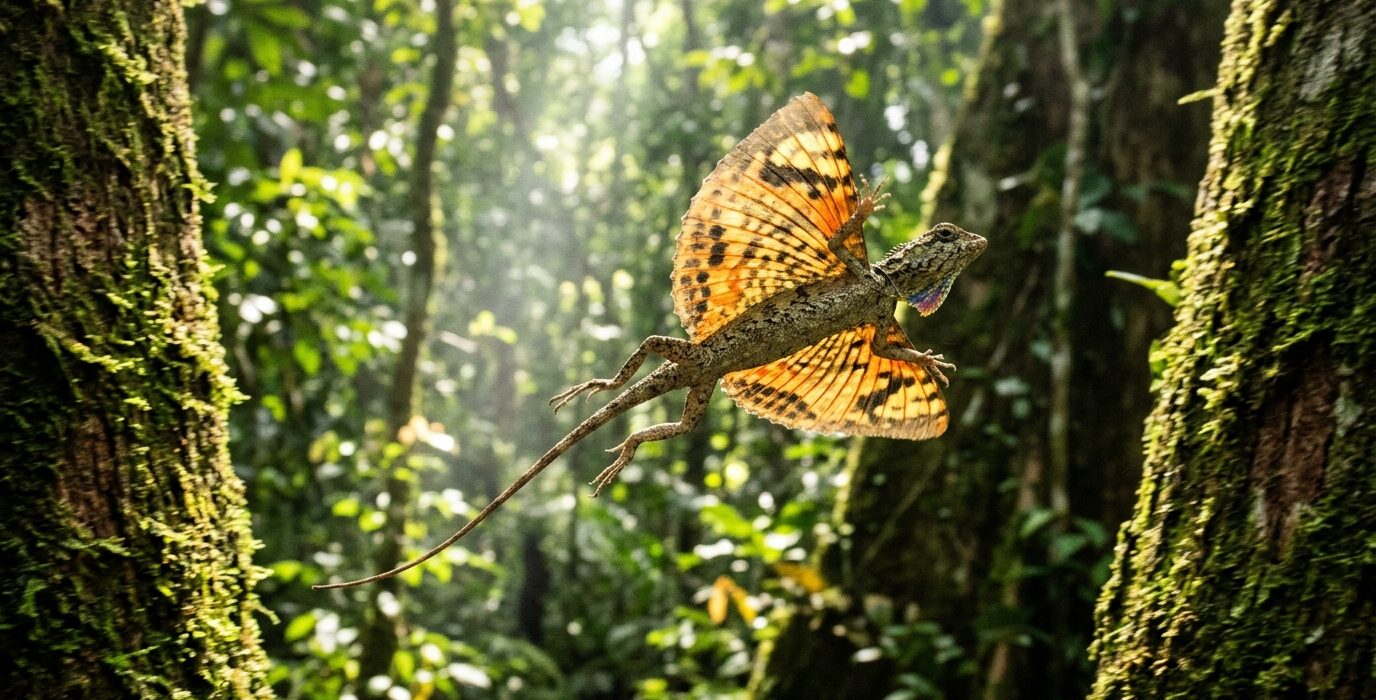
Flying Dragon Lizard
The flying dragon lizard is a remarkable reptile known for its ability to glide between trees in tropical forests. Also called Draco lizards, these small creatures possess movable ribs that can extend outward. A colorful membrane of skin stretches across these ribs to form wing-like structures. When the lizard jumps from a branch, it opens this membrane to catch the air. This adaptation helps the animal escape predators and travel efficiently through its arboreal home.
Most species of these gliding reptiles live in the dense rainforests of Southeast Asia. They spend nearly all of their lives high up in the tree canopy. Observers rarely spot them on the forest floor unless a female descends to lay her eggs in the soil. Because their coloring blends well with tree bark, spotting them requires patience and sharp eyes. Their survival depends entirely on maintaining healthy forested habitats.
Understanding these lizards requires looking closely at their unique physical features and daily habits. Scientists study them to learn more about early gliding evolution in vertebrates. While they cannot flap their wings to gain altitude, their steering control is surprisingly precise. They adjust their path mid-air by tilting their wing membranes and using their long tails as rudders. This article examines how these animals live, move, and interact with their environment.
Naturalists often marvel at how such a small animal masters the art of aerial travel. Their bright throat fans, known as dewlaps, also play a major role in territorial displays and mating rituals. Males flash these colorful flaps to warn rivals away or attract potential partners. Every physical trait serves a specific purpose in the high treetops. Examining these behaviors reveals the complex strategies required for life in the canopy.
Readers searching for detailed information on these reptiles will find a complete breakdown of their biology below. Each section explores a different aspect of their existence, from basic anatomy to common misconceptions. Careful observation in the wild continues to reveal new details about their behavior. By exploring these topics, you will gain a clear picture of how these fascinating creatures survive.
What Is a Flying Dragon Lizard in Plain Words
Defining the Draco Lizard Family
The flying dragon lizard belongs to the genus Draco, which includes numerous species of small arboreal reptiles. These animals are famous for the membranous wings folded against their sides when not in use. They rarely grow longer than a human hand, including their very slender tails. Their scales feature shades of brown, gray, and green to match tree bark. This camouflage makes them almost invisible against the backdrop of a rainforest trunk.
Recognizing Physical Characteristics
An adult Draco lizard features an elongated body designed for life among the branches. Their ribs are completely modified compared to other lizards, acting as structural supports for their glide wings. Males usually possess a longer throat fan than females, which they extend during social interactions. Their claws are sharp and curved, providing a secure grip on rough bark. These physical traits combine to make them perfectly suited for vertical forest environments.
Understanding Their Taxonomy and Distribution
Taxonomists classify these lizards within the family Agamidae, a large group of Old World iguanians. They inhabit the tropical rainforests of Southeast Asia, ranging from southern India through Indonesia and the Philippines. Different species occupy specific island regions or forest types, showing remarkable local adaptation. Because they rely heavily on tall trees, deforestation poses a severe threat to their populations. Conservation efforts must protect old-growth forests to ensure their continued survival.
How the Gliding Mechanism Works
Extending the Rib Wings
The gliding ability relies on a specialized set of ribs that can swing outward from the body. Muscles pull these ribs away from the torso, stretching the attached skin tight like a kite. When the lizard decides to move to a lower branch or an adjacent tree, it simply leaps. The wing membranes open automatically due to air pressure as the animal falls. This clever design requires very little energy compared to powered flight.
Steering and Landing Dynamics
Airborne control involves subtle adjustments of the body and tail during descent. The lizard tilts its extended ribs to catch crosswinds and alter its glide angle. Its long, whip-like tail acts as a rudder to keep the body stable in mid-air. Before hitting the target tree, the lizard pulls its body upward to slow its forward momentum. It grasps the bark securely with its sharp claws the moment it lands.
Physics of Passive Flight
This form of locomotion is technically gliding rather than true powered flight. The animal converts potential height into horizontal distance, losing altitude steadily from launch to landing. Some individuals can travel several meters in a single leap across a gap between trees. Air resistance supports their lightweight bodies, allowing them to cross wide spaces safely. Without this skill, moving between isolated trees on foot would expose them to ground predators.
Where and When These Lizards Live
Choosing Rainforest Habitats
Flying dragon lizards inhabit warm, humid tropical rainforests and secondary growth woodlands. They require a dense canopy with plenty of mature trees spaced close together. Sunlight filtering through the leaves creates warm patches where the lizards regulate their body temperature. They avoid the dark, damp forest floor for almost their entire lives. Finding the right tree density is essential for their daily foraging and travel needs.
Active Daytime Behavior
These reptiles are strictly diurnal, meaning they remain active only during daylight hours. Mornings usually begin with basking on sunlit tree trunks to warm their cold-blooded bodies. Once warm enough, they hunt for small insects like ants and termites crawling along the bark. Afternoon hours involve territorial displays and occasional glides to fresh hunting grounds. As dusk approaches, they settle into crevices or under leaves to sleep.
Real Situations in the Wild
Travelers in Southeast Asian national parks occasionally spot them zooming between tree trunks. For example, a researcher walking through a Bornean reserve might see a flash of yellow and black membrane. The lizard lands rapidly on a nearby trunk, folds its wings instantly, and scampers higher up. Such encounters highlight how well their camouflage works until movement gives them away. Observers must remain quiet and still to watch their natural behaviors without causing panic.
What Flying Dragon Lizards Can and Cannot Do
Capabilities in the Canopy
These creatures excel at escaping arboreal predators like tree snakes and birds by launching into sudden glides. They can cover distances many times their own body length in a matter of seconds. Their hunting skills allow them to catch fast-moving insects using quick strikes with their jaws. They navigate complex branch networks with speed and agility. Their specialized grip prevents them from slipping during steep climbs.
Limitations on the Ground
Walking on flat ground presents a serious challenge for these specialized tree-dwellers. Their long rib structures and weak leg proportions make terrestrial movement awkward and slow. On the forest floor, they become easy targets for ground-dwelling predators such as small mammals and birds. Therefore, they only touch the soil when females descend to bury their eggs in damp earth. Once egg-laying finishes, they return to the safety of the trees immediately.
Absence of Powered Flight
While they glide impressive distances, these lizards cannot generate lift through muscle flapping. They cannot gain altitude or sustain a flight path that rises above their launch point. Every glide is a controlled fall toward a lower elevation. This limitation restricts their range to sloped forests or tall trees where height is readily available. Understanding this distinction separates gliding reptiles from true flying animals like birds and bats.
Common Wrong Ideas About Draco Lizards
Debunking Mythical Origins
Local folklore in some regions paints these lizards as miniature dragons capable of breathing fire or flying great distances. In reality, they are harmless insectivores that pose no threat to humans or livestock. Their wings are simply modified ribs, not magical appendages. Science has replaced these old myths with clear facts about their evolution and anatomy. Education helps dispel fears and encourages local conservation of their forest homes.
Misconceptions About Flight
Many people assume these animals fly like birds or insects because of their popular name. However, their lack of breastbones suited for flight muscles proves they cannot flap their wings. They glide downward in a manner similar to flying squirrels or gliding frogs. Recognizing this mechanical difference helps clarify how different animal groups evolved similar solutions to forest life. Physics dictates that passive gliding is the only airborne method available to them.
Diet and Handling Myths
Another frequent mistake involves believing these lizards eat plant matter or require complex diets in captivity. They feed almost exclusively on live insects, particularly ants and termites, which they hunt actively. Keeping them as pets is generally discouraged because their specialized wild needs are nearly impossible to meet indoors. Wild populations belong in their native rainforests where they can find proper food and space. Removing them from the wild damages local ecosystems and usually leads to early death for the animal.
Frequently Asked Questions
Can a flying dragon lizard actually fly?
No, they cannot fly using muscle power. They glide downwards from high trees by extending skin membranes over their ribs.
What do flying dragon lizards eat?
They eat small insects, with ants and termites making up the vast majority of their daily diet.
Why do they have colorful flaps on their throats?
Males use these bright throat fans to defend territory and attract mates during the breeding season.
Do these lizards live in groups?
They are generally solitary animals that defend small territories on individual trees from other rivals.
Are flying dragon lizards endangered?
Most species are not currently endangered, but deforestation threatens local populations by destroying their forest canopy habitats.
Conclusion
The flying dragon lizard demonstrates how nature solves complex survival challenges through remarkable physical adaptations. Their specialized rib wings and gliding skills allow them to navigate the forest canopy with ease. While they cannot achieve true powered flight, their aerial movement remains a marvel of evolution. Protecting these unique reptiles requires preserving the old-growth tropical forests they call home. If you want to learn more about arboreal wildlife, consider exploring field guides on Southeast Asian rainforest ecology.